The Guises of the Morrigan - The Irish Goddess of Sex & Battle by Rankine David & d'Este Sorita
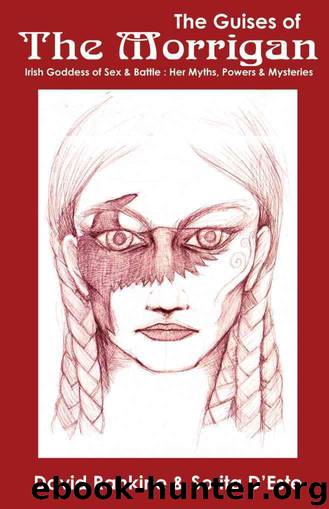
Author:Rankine, David & d'Este, Sorita [Rankine, David]
Language: eng
Format: azw3
Publisher: Avalonia
Published: 2012-01-16T16:00:00+00:00
The Banshee – A survival of the Morrígan in folklore
“In her home, with bent head, homeless,
Clasping her knees she sits,
Keening, keening!
And at her keen the fairy-grass
Trembles on dun and barrow;
Around the foot of her ancient crosses
The grave-grass shakes and the nettle swings;
In haunted glens the meadow-sweet
Flings to the night wind
Her mystic mournful perfume;
The sad spearmint by holy wells
Breathes melancholy balm.”[clxxviii]
Whilst the strong and feisty nature of the Morrígan ensured she would not be incorporated into Christianity as a saint, like other deities such as Bride; she nevertheless made the more gentle translation into folklore as the banshee or bean sí. This attribution is made clear by the names and attributions associated with the banshee.
This transition may largely be due to the incompatibility of the Morrígan with Christianity. In her comprehensive work The Banshee, Patricia Lysaght notes, “Although certain Christian ideas and concepts enter into the death-messenger complex, it is in the main surprisingly a-Christian.”[clxxix]
Some evidence does suggest though that the concept of the banshee existed by the eighth century. The Annals of Ulster for 737 record: “Cernach son of Fogartach is treacherously slain by his wicked companions; the calves of cows and the women of the lowest world wearisomely lamented him.”
This intriguing entry gives a historical figure associated with mythical beings, for the lowest world is a reference to the faery realms, and the lamenting suggests the banshee, although the banshee normally foretold death rather than lamenting afterwards.[clxxx]
Across Ireland there are three main names associated with the banshee. These are bean sí, bean chaointe and badhbh. Let us consider these three terms in turn. Bean sí translates literally as faery woman, bean chaointe as keening woman, and badhbh as has already been stated means scald crow.
All of these names are obviously linked with the Morrígan, in her role as Faery Queen, her role as the Washer at the Ford, and in her guise of Badhbh. Hence we see “Badhbh: a female fairy or phantom, said to be attached to certain families, appearing as a scald-crow or Royston-crow.”[clxxxi]
Banshees are usually described as being hideously ugly old hags (like some of the descriptions of Badb) or beautiful women with long golden hair and white dresses. This is a classic faery description recalling the Morrígan as Faery Queen. Whether ugly or beautiful her hair is usually described as being anything from waist-length to so long that it reaches the ground.[clxxxii]
It is recorded as a common occurrence that the banshee would howl in groups of three wails,[clxxxiii] a number classically associated with the Morrígan. This is emphasised further by this trait being originally associated with the badhbh variant of the banshee and spreading to the other named aspects.[clxxxiv] This makes sense as the crying of crows and ravens was seen as prophetic (see the excerpt from MSS Trinity H.3.17 in Appendix iv) and may be the source of the banshee’s cry.
Although not associated directly with water, the banshee is often linked with water. “She is more commonly imagined to appear close to water, at lakes, rivers or wells.
Download
This site does not store any files on its server. We only index and link to content provided by other sites. Please contact the content providers to delete copyright contents if any and email us, we'll remove relevant links or contents immediately.
Professional Troublemaker by Luvvie Ajayi Jones(29774)
Empire of the Sikhs by Patwant Singh(23212)
Twilight of the Idols With the Antichrist and Ecce Homo by Friedrich Nietzsche(18785)
Plagued by Fire by Paul Hendrickson(17547)
The Sun and Her Flowers by Rupi Kaur(14653)
Norse Mythology by Gaiman Neil(13589)
Fangirl by Rainbow Rowell(9484)
A Journey Through Charms and Defence Against the Dark Arts (Harry Potter: A Journey Throughâ¦) by Pottermore Publishing(9343)
Adultolescence by Gabbie Hanna(9026)
Wonder by R.J. Palacio(8732)
Tools of Titans by Timothy Ferriss(8615)
Becoming Supernatural by Dr. Joe Dispenza(8381)
How to Bang a Billionaire by Alexis Hall(8291)
Wonder by R. J. Palacio(8265)
Crystal Healing for Women by Mariah K. Lyons(8012)
The Road Less Traveled by M. Scott Peck(7745)
The Lost Art of Listening by Michael P. Nichols(7628)
The Witchcraft of Salem Village by Shirley Jackson(7440)
The Institute by Stephen King(7171)
